


Space

Protection

Safety & Security

Stimulation
Space - Outdoor Environments
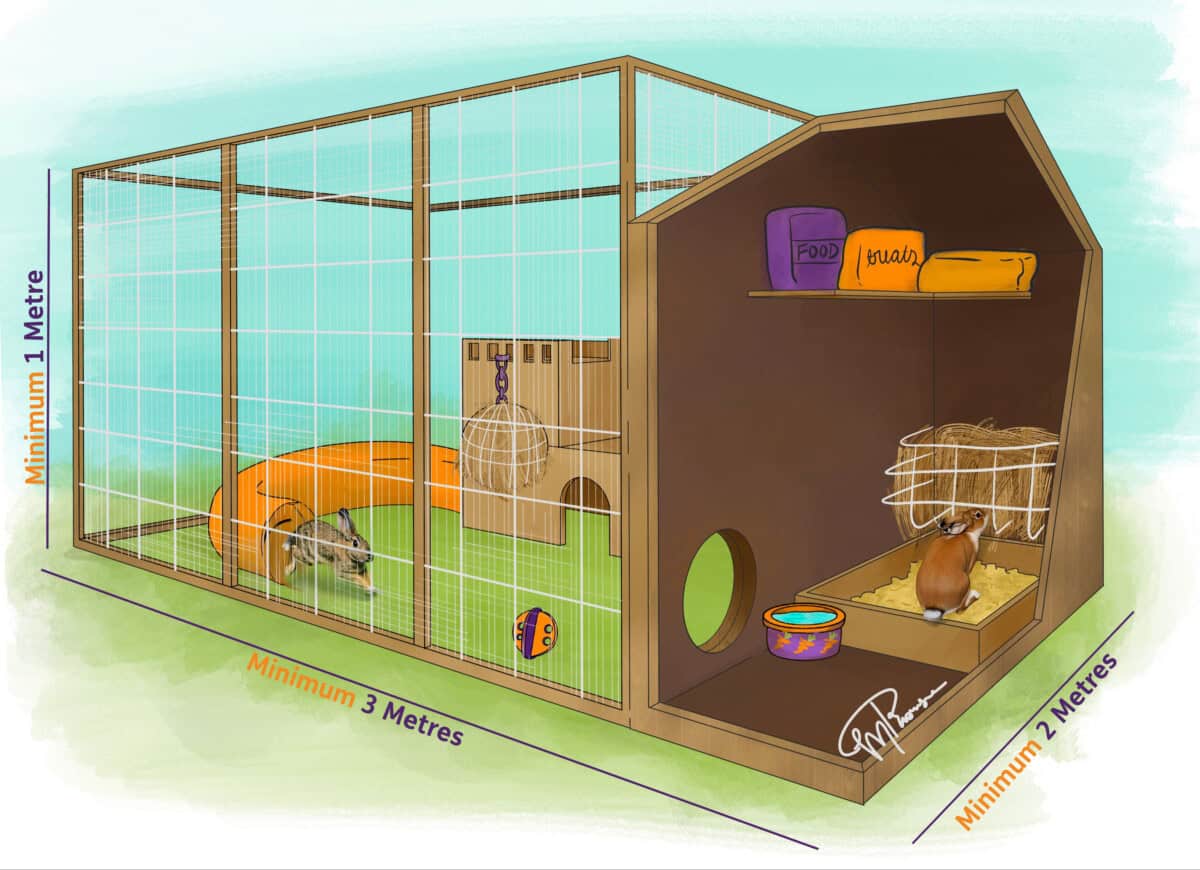
The RWAF’s latest recommendation is to aim to provide an overall environment for your rabbits of 3m x 2m (slightly larger than 10ft x 6ft), or equivalent. This should incorporate a combination of living space (traditionally a hutch) and exercise space (traditionally an exercise run).
Rabbits must have constant access to their full environment, choosing for themselves when to relax in their sheltered space or binky around their exercise space.

Sheltered Living Space
For outdoor rabbits, a sheltered space is required within the environment. This space should be a minimum of 6ft (183cm) x 2ft (61cm) x 2ft(61cm).
Most commercially available hutches and indoor cages are therefore considered to be too small and you may need to think "outside the box" in terms of suitable accommodation.
Outdoors, garden sheds, and children's playhouses can easily and cheaply be adapted to make excellent living accommodation for your rabbit. Sheds offer a great space for owners to share socialisation time with their rabbits whilst also sheltering from the weather and we find that owners will spend more time with their rabbits when using sheds in place of traditional hutches. Check out our recommended suppliers for suggestions of environments that make the space an inviting place for you as well as your rabbits.
Within their living area, there should be facilities for sleeping (lots of warm bedding such as straw, blankets, paper, etc), an area for toileting (ideally with a litter pan in place), and an area for eating with plenty of hay, fresh veg & herbs and a small volume of dried rabbit pellets (only about an egg cup size per day) and of course, freshwater supplied preferably in a bowl or gravity feeder.
Permanent Exercise Space
Just as important is ensuring that your rabbits are getting plenty of exercise.
Our minimum requirement is that the living area have a permanently attached exercise area that allows the rabbits to choose when they want to be in their living space or their exercise space.
A range of connection systems are available to allow you to connect large hutches and sheds to permanent access space via burrow pipes and tunnels.
Access to run and exercise space is required at all times. Owners may consider closing access to exercise areas overnight, based on safety and protection from predators. We do not support this approach and, therefore, encourage owners to consider all other safety precautions to prevent predator attacks. This is because rabbits are most active at dawn and dusk and we should not prevent them from the opportunity to demonstrate their natural behaviours.
Our minimum requirement for exercise space is incorporated within the overall 3m x 2m requirements.
Protection
Your rabbits' environment needs to consider protection from weather & predators. Rabbits can cope with reasonable dips in temperature but are often harmed by harsh winds and rains rather than low temperatures. And the mere sight of a fox can be enough to startle your rabbit to death.

Safety & Security
We live in a complex and often confusing world, and the reality is that our pet rabbits aren’t as secure as we would like them to be in our homes and gardens. Many people consider safety from foxes but often forget about other predators, such as birds of prey and stoats.
Sadly, they are also not safe from other humans. There are many reported cases of rabbits being deliberately stolen, let free from their environment, or abused and tortured.
Your rabbits’ environment, therefore, needs to consider additional security measures.

Stimulation
Rabbits are highly intelligent, social, interactive animals who get bored very easily.
We look for adopters to consider ways to make sure their rabbits are stimulated and entertained within their environments.


